

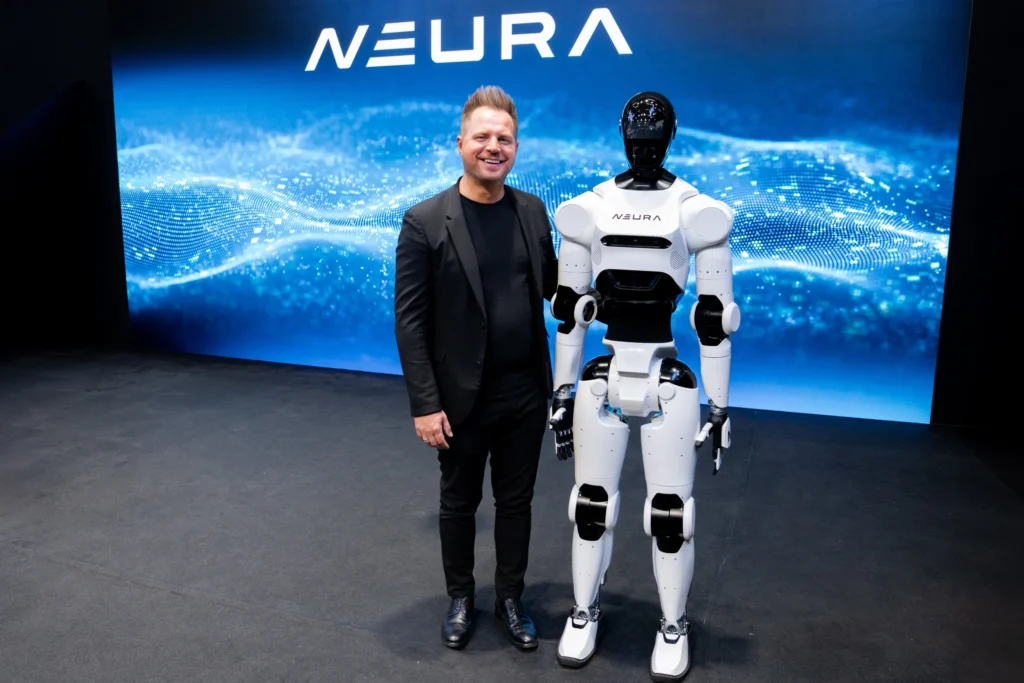
On June 10, 2026, German robotics company NEURA Robotics announced one of the largest funding rounds in the history of the sector: up to $1.4 billion in Series C financing. The round is led by Tether and includes participation from Qualcomm Technologies, Amazon, NVIDIA, imec.xpand, Bosch, Schaeffler, the European Investment Bank, Lingotto Horizon, InterAlpen Partners, and others.
While headline-grabbing valuations and humanoid demos dominate much of the robotics conversation, this round is notable for its focus on infrastructure — data, training environments, edge compute, and shared intelligence — rather than just another robot platform.
The Numbers Behind the Round
- Round size: Up to $1.4 billion (described by the company as the largest Series C for a full-stack robotics company to date)
- Existing commercial traction: Order book and strategic deployment pipeline already exceed $1 billion
- Production target: Serial production scaling toward several million robots by 2030
- Geographic expansion: Manufacturing and deployment infrastructure scaling from its European base into the US, China, and Japan
These figures position NEURA as one of the best-capitalized Western players in physical AI, with meaningful revenue visibility already in place.
The Technical Thesis: Neuraverse + NEURA Gyms
NEURA’s core bet is not primarily on building a single superior humanoid, but on creating the data and learning infrastructure that makes fleets of cognitive robots viable at scale.
Neuraverse is described as an open Physical AI ecosystem in which robots continuously exchange skills, capabilities, and real-world learning across deployments. It integrates:
- Hardware (arms, mobile platforms, humanoids)
- In-house AI and software
- Sensors
- Edge compute
- Large-scale learning infrastructure
The goal is to move beyond isolated, narrowly trained robots toward systems that can share intelligence in a decentralized way.
The most distinctive technical element is NEURA Gyms — large-scale, purpose-built real-world training facilities. These combine:
- Direct physical sensor interaction with the real world
- Simulation
- Multimodal learning pipelines
This creates one of the more ambitious attempts at building high-quality, grounded robotics datasets at industrial scale. In an industry where simulation-to-real gaps remain a major bottleneck, the explicit investment in physical training environments at this funding level is significant.
4NE1 Humanoid: Core Platform Specifications
NEURA’s flagship humanoid, the 4NE1, is designed for safe, direct collaboration with humans in unstructured environments (no safety cages required in many use cases).
Key specifications include:
- Height: 180 cm
- Weight: ~80 kg
- Walking speed: Up to 5 km/h
- Payload: Up to 100 kg peak (continuous payload in the 15–20 kg range depending on configuration)
- Runtime: 6–8 hours with hot-swappable batteries enabling 24/7 operation
- Sensing: Patented artificial skin for pre-contact proximity detection, force-torque sensing in all joints, 360° multimodal perception, Omnisensor for human/object distinction
- AI approach: Multimodal models + reinforcement learning, with strong emphasis on on-device/edge inference
- Processor: Reports indicate NVIDIA Thor T5000-class compute
- Safety architecture: Designed around pre-contact sensing and adaptive behavior rather than purely reactive collision avoidance
The robot also features exchangeable forearms and options for wheeled bases or extended-reach configurations, reflecting a pragmatic, application-first design philosophy.
Why the Investor Mix Matters Technically
The investor group is unusually strong on both the compute/edge and industrial manufacturing sides:
- Qualcomm brings deep expertise in on-device AI, high-performance edge computing, and connectivity — critical for safety-critical, low-latency robotics.
- NVIDIA provides the GPU/accelerator stack (visible in the 4NE1 compute choices).
- Amazon contributes cloud infrastructure (Bedrock, SageMaker, Trainium/Neuron) for the parts of the stack that benefit from centralized training or orchestration.
- Bosch and Schaeffler bring real manufacturing scale, component expertise (sensors, actuators, motion systems), and credibility with European industrial customers.
- Tether’s involvement adds an interesting angle around machine-native economic systems and edge-first autonomy (local decision-making and transaction capability without constant cloud dependency).
This combination suggests NEURA is building for hybrid edge-cloud operation with strong industrial deployment in mind, rather than pure research or consumer toy platforms.
Strategic Implications
This round reinforces a growing divergence in the physical AI landscape:
- US players (Tesla, Figure, Apptronik, etc.) often emphasize end-to-end learning, massive simulation, and rapid iteration backed by Silicon Valley capital.
- Chinese players are winning on cost, speed-to-volume, and supply chain density.
- NEURA is positioning as the European infrastructure play — strong on safety, industrial integration, edge intelligence, and shared learning systems.
The explicit focus on Neuraverse (shared robot intelligence) and NEURA Gyms (real-world data generation at scale) addresses two of the hardest problems in robotics today: data quality/quantity and transfer of skills across embodiments and environments.
Whether this infrastructure-first approach delivers faster real-world deployment than pure model-scaling strategies remains to be seen. However, with >$1B in order book visibility, deep industrial partnerships, and now substantial capital, NEURA has moved from “promising European startup” to a serious contender in the global physical AI race.
This is one of the more substantive infrastructure bets in robotics right now. The next 18–24 months of execution on NEURA Gyms rollout, 4NE1 deployments, and actual data flywheel effects will be worth watching closely.